

The Little Garden Hare Who Met Jesus
Summary
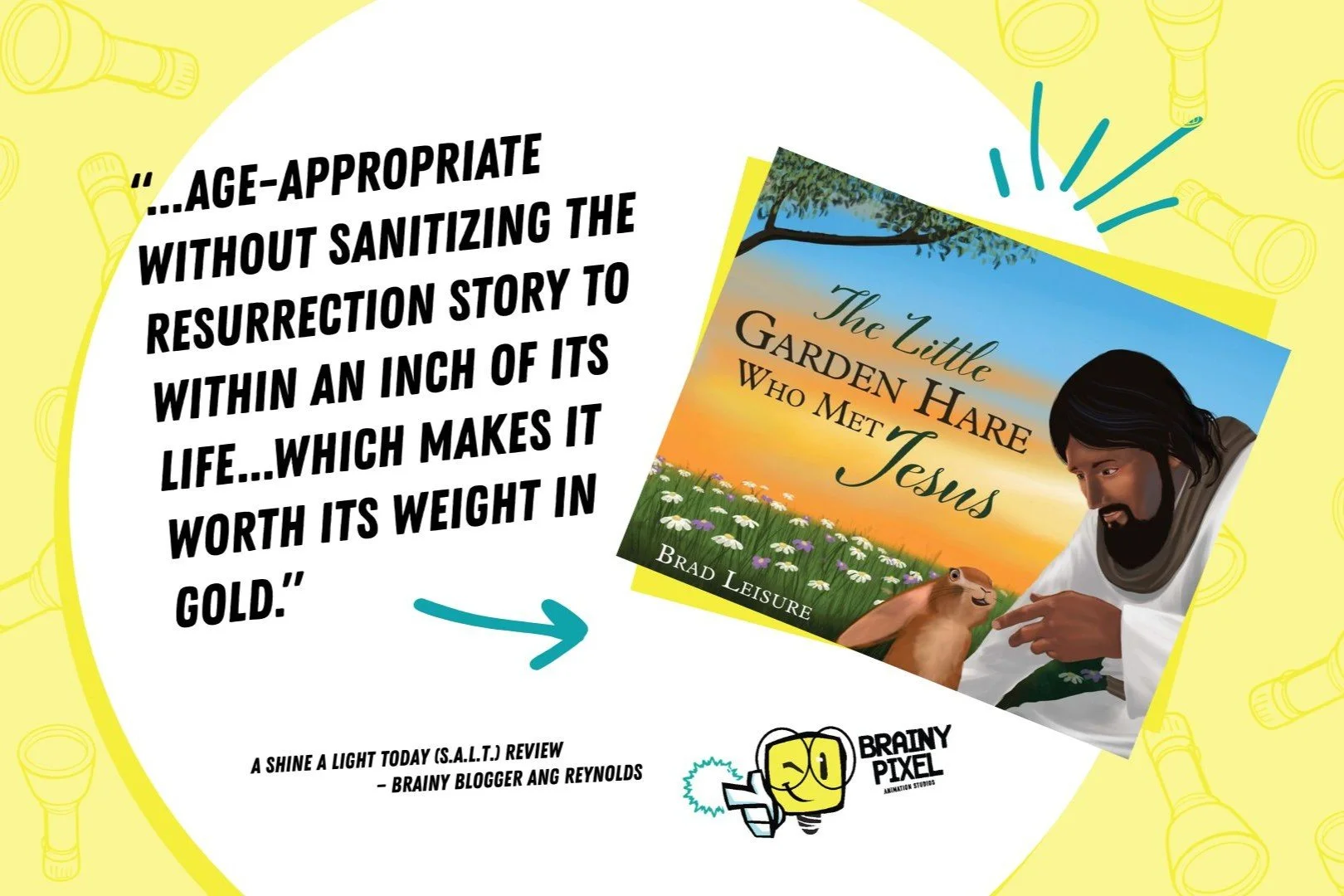
The Little Garden Hare Who Met Jesus is a children’s picture book by Brad Leisure. In it, a little garden hare named Shayna is separated from her family. Through her adventure, the story of Jesus’ capture, death, and resurrection unfold through bucolic illustrations.
Assessment
The Little Garden Hare Who Met Jesus is the story of Jesus’ death and resurrection as told from the perspective of an unlikely observer: a nearby hare. From the Garden of Gethsemane to Peter’s denial to the Empty Tomb, this book seeks to tell the whole of the resurrection story from the Gospel of John in a kid-friendly way. Despite relying a bit too much on defamiliarization and suffering from some clunky writing, the story does break down these events in an approachable way. It also includes a lot of details that are often missed with other versions designed for kids.
The artwork is cute and well-drawn, aiding the story without distracting from it. The theological message is solid, taking most or all of the major events playing out in the story directly from the Gospel of John. It terms of cleanliness, the story is dealing with the events of Jesus’ death on the Cross, so it is not without violence. There are also a few lines that may be a little intense for some more sensitive children, but there is no excessive violence or gore.
Light-o-Meter
Overall — 4 out of 7 Little Lights
Story: 4 out of 7 Little Lights
Artwork: 4 out of 7 Little Lights
Quality: 4 out of 7 Little Lights
Theological Message: 5 out of 7 Little Lights
Age Appropriateness — Appropriate in terms of cleanliness for intended audience.
Talk
First of all, I absolutely love this book’s heart for sharing the resurrection story kids. These are the kinds of stories that we need and we need lots of to help us teach the love of Christ to even the littlest ones. For that, the story gets full marks. The concept of defamiliarization is also an incredibly valid storytelling tool; if you don’t know what it is, it is basically a form of describing something familiar as if it were strange or unfamiliar. So, a “basketball” becomes a “orange orb to play sports with”. It’s a great tool for helping break concepts down and play with ideas, especially for kids.
However, I did think this story leaned a little too heavily on its defamiliarization framework. Sometimes it seemed the story was getting a little lost in its descriptions and some of the writing was a bit clunky or unclear. While I wouldn’t normally go into such a deep literary analysis of a kids’ illustrated book, this one is trying to convey the most important event in human history, so I want to be a little more particular. My fear with this story is that — on its own — it might make some of the events of Jesus’ death and Resurrection a little murky depending on what the kid already knows about these events.
Now, onto the big thing I really liked is that: this book has a lot of really great details that are often left out in “kids’ versions” of these events. Everything from Jesus sweating blood in the Garden of Gethsemane to Peter’s denial to how long Jesus was on the Cross and who saw Him first was all included in a very complete picture of this story. That makes the book absolutely worth its weight in gold, in my opinion, because its easy to go “ah, the kids don’t need all these details”. It is true, sometimes kids do not need all of the details, but if all we’re giving them is stripped down, bare-bones stories from the Bible, they are going to grow up missing a lot of nuance.
This book kept things age-appropriate without sanitizing the story to within an inch of its life, something that often happens in these kinds of retellings. Yes, it does have a few lines about Jesus’ death that might be a little intense — although the artwork is clean — but His death was intense, and horrible and while we don’t want to traumatize the children, we also don’t want to undercut the price that had to be paid for our sin.
I think the last thing I want to say about this book is that it is a great tool for the story aspect of the trial, death, and resurrection of Jesus, but it did not necessarily loop things around to the Gospel; i.e. it does not really explain why Jesus went on trial, died, and was resurrected. With that, I do recommend parents and caregivers either explain this purpose themselves before or after reading the book or find another resource that goes into it.